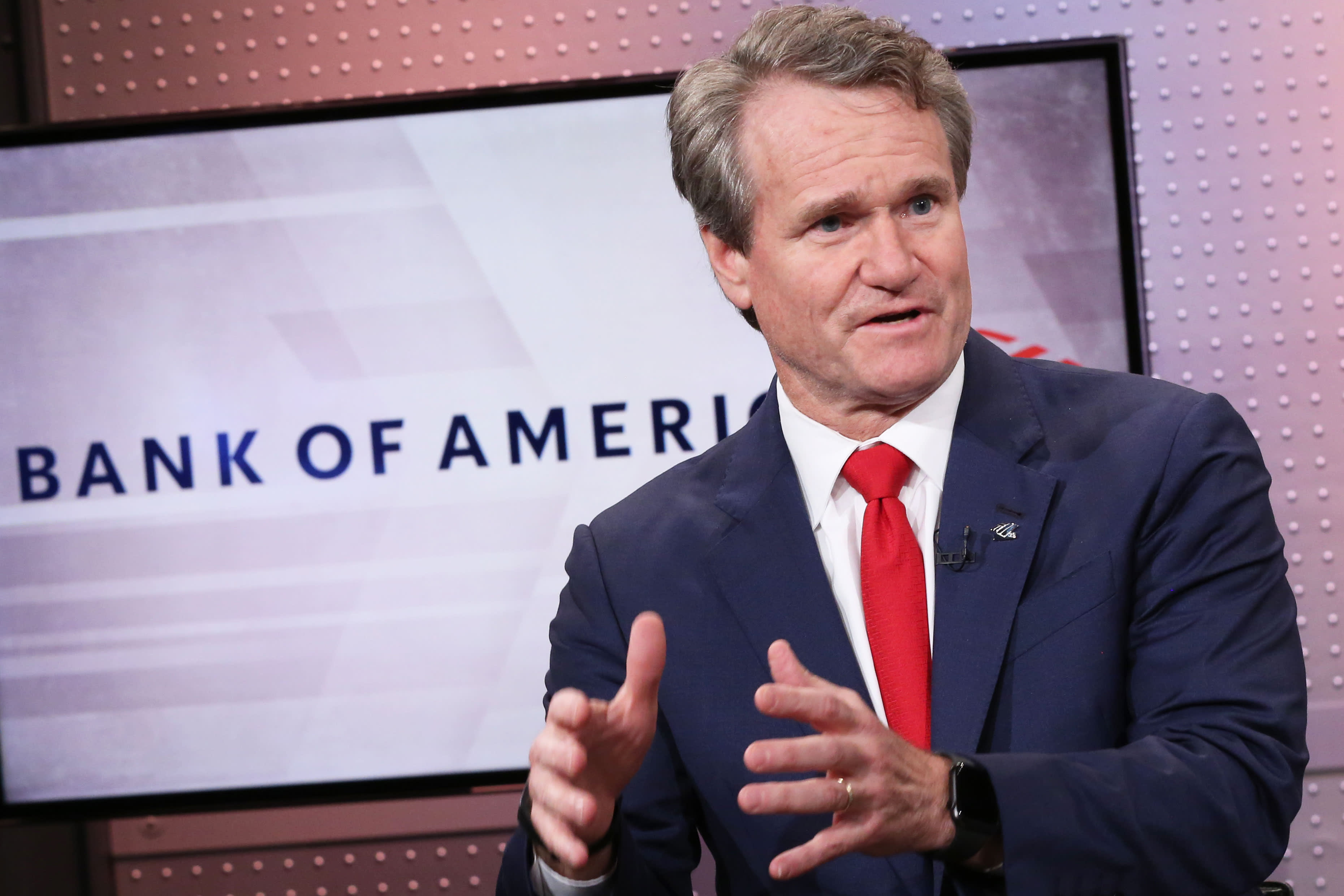
Bank of America reported first-quarter earnings that topped Wall Street estimates on booming investment banking and trading results, as well as the release of loan loss reserves as fewer consumers defaulted on loans than expected because of the pandemic.
Here are the numbers:
- Earnings: 86 cents a share, vs. 66 cents a share expected by analysts polled by Refinitiv.
- Revenue: $22.9 billion, vs. $22.1 billion expected.
Other key figures:
- Provision for credit losses fell $6.6 billion to a benefit of $1.9 billion, reflecting a reserve release of $2.7 billion.
- Record investment banking fees of $2.2 billion.
- Record equity underwriting fees of $900 million.
- FICC trading up 22% to $3.3 billion.
- Equity trading up 10% to $1.8 billion.
The shares gained 1.3% in early trading.
Bank of America, the second-biggest U.S. lender by assets, set aside $11.3 billion for credit losses last year, when the industry believed that a wave of defaults tied to the coronavirus pandemic was coming. Instead, government stimulus programs appear to have prevented most of the feared losses, and banks have begun to release more of their reserves this quarter.
Like JPMorgan and Goldman, the bank also saw a boost from its trading operations.
On Wednesday, JPMorgan Chase and Wells Fargo each posted results that exceeded analysts’ expectations on reserve releases, while Goldman Sachs beat estimates on strong advisory and trading results.
Shares of Bank of America have climbed 32% this year, exceeding the 26% gain of the KBW Bank Index.
This story is developing. Please check back for updates.
Enjoyed this article?
For exclusive stock picks, investment ideas and CNBC global livestream
Sign up for CNBC Pro
Start your free trial now