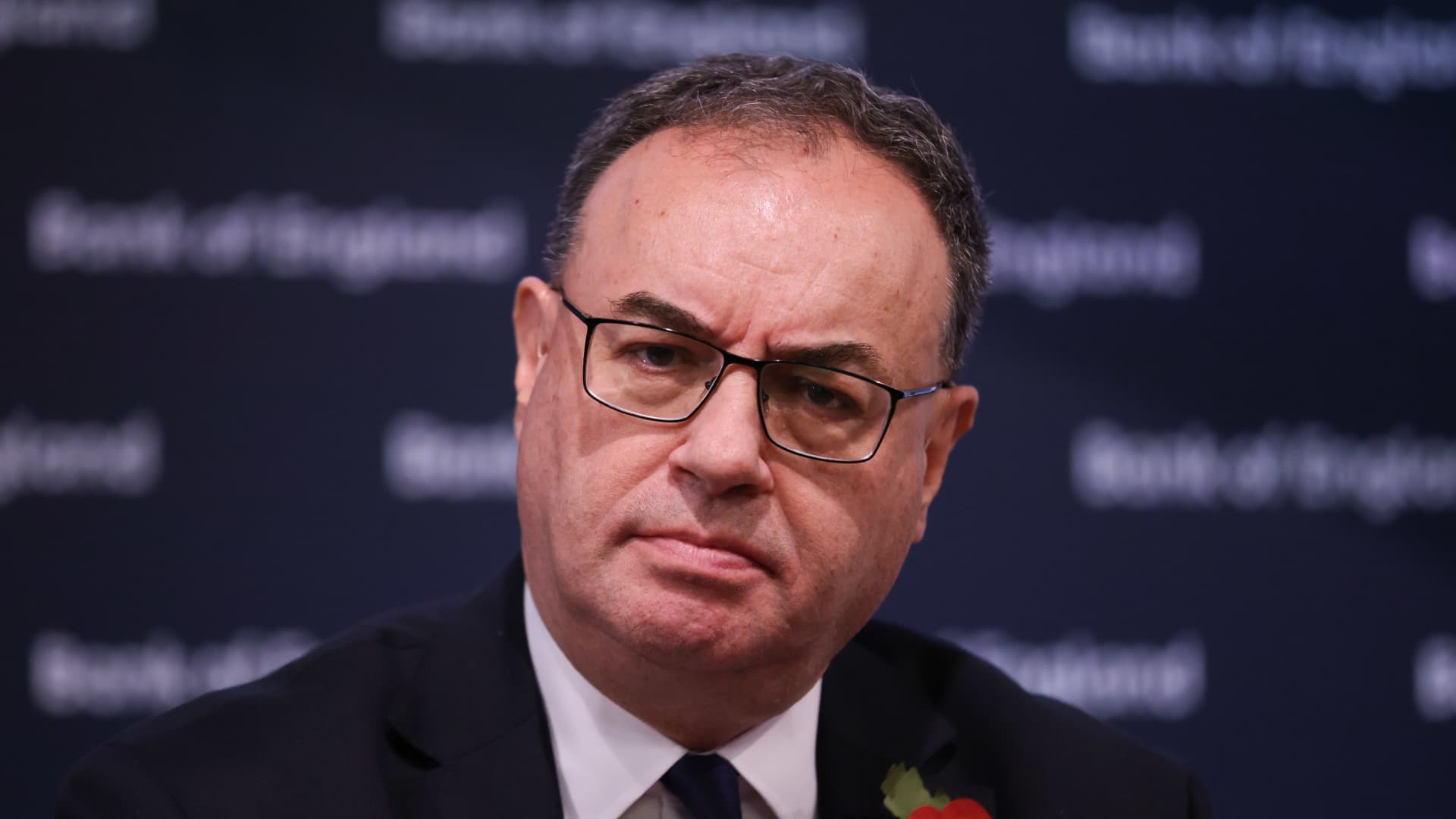
Bank of England Governor Andrew Bailey said Thursday that the ongoing Israel-Hamas war poses a potential risk to the bank’s efforts to bring down inflation.
Andrew Bailey told CNBC that aside from the immense human tragedy brought about by the now almost four-week conflict, the possible knock-on effects for energy markets were significant, risking a resurgence in price rises.
“So far, I would say, we haven’t seen a marked increase in energy prices, and that’s obviously good,” Bailey told CNBC’s Joumanna Bercetche.
“But it is a risk. It obviously is a risk going forward,” he said.
Oil prices have fluctuated over recent weeks as investors have eyed developments in the Middle East amid concerns that the fighting could spill over into a wider conflict in the energy-rich region.
The World Bank warned in a quarterly update Monday that crude oil prices could rise to more than $150 a barrel if the conflict escalates. As of Thursday 3:30 p.m. London time, Brent crude was trading up just over 1% at $85.65 a barrel.
Bailey said that, should energy prices push significantly higher, the central bank’s response would depend on the wider economic circumstances and how persistent policymakers expect the price rises to be.
The Bank of England has been steadfast in its efforts to bring down inflation, only ending its run of 14 consecutive interest rate hikes in September after data showed inflation running below expectations.
On Thursday, the bank held interest rates steady once again but said that monetary policy would need to remain tight for an “extended period of time.”
The Monetary Policy Committee voted 6-3 in favor of keeping the main Bank rate at 5.25%, with three members preferring another 25-basis point hike to 5.5%.
“We’re going to have to hold them [interest rates] in restrictive territory for some time,” Bailey said.
“The risks are still on the upside,” he continued. “It’s really just too soon to start talking about cutting interest rates.”
U.K. inflation came in at 6.7% in September, slightly ahead of expectations and unchanged from the previous month.
The Bank now expects the consumer price index to average around 4.75% in the fourth quarter of 2023 before dropping to around 4.5% in the first quarter of next year and 3.75% in the second quarter of 2024.