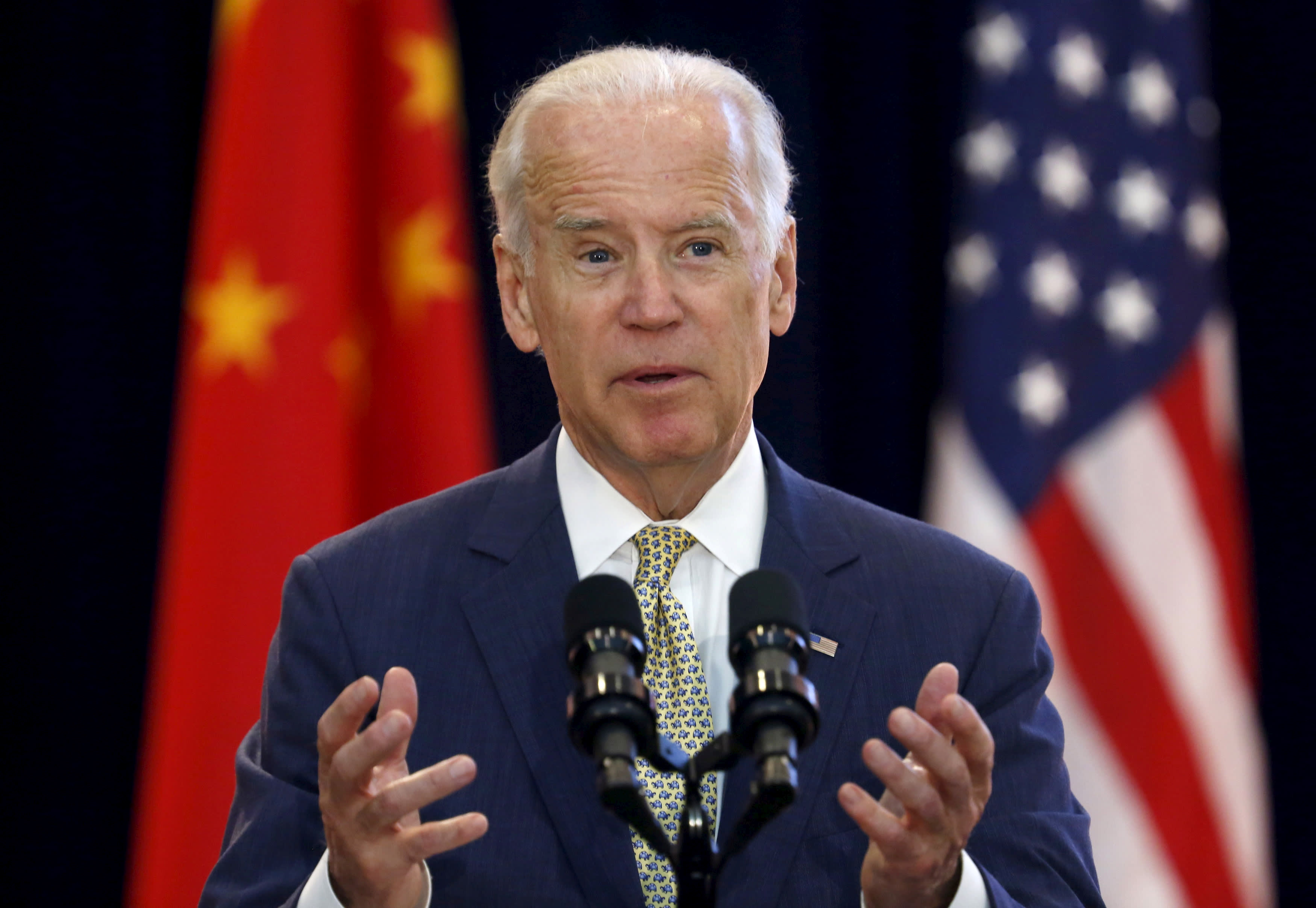
U.S. Vice President Joe Biden delivers remarks at the Strategic and Economic Dialogue (S&ED) at the State Department in Washington, U.S. June 23, 2015.
Yuri Gripas | Reuters
BEIJING — Hope is fading for a significant change in U.S.-China relations under President-elect Joe Biden, Alicia Garcia-Herrero, Natixis’ chief economist for Asia-Pacific, said on Thursday.
Relations between the U.S. and China have spiraled downward under President Donald Trump‘s administration in the last four years.
Ahead of the election, Natixis economists had hoped the two countries could return to better terms under new leadership in the White House.
“Frankly speaking, the first words we’ve heard from Biden aren’t very appealing,” Garcia-Herrero said on a call with reporters.
Over the last four years, Trump’s administration has used tariffs, sanctions and strongly worded statements against Beijing. The tough approach sought to address longstanding complaints about unfair business practices such as forced technology transfers and intellectual property theft.
But Trump’s “America First” platform and tendency toward abrupt announcements on Twitter disturbed many U.S. allies. The uncertainty and tariffs also hurt many businesses, both American and Chinese.
No reset in sight
On Monday, Chinese Foreign Minister Wang Yi told a group of American business leaders the U.S. should cease its “interference” in China’s domestic affairs in order to improve relations between the two countries.
“The stakes are getting higher, not lower,” Garcia-Herrero said, describing her surprise at the heightened tension amid expectations for better U.S. economic growth. “I don’t think we’ll have a reset.”
The U.S. and China reached a temporary truce in January with the signing of a “phase one” trade agreement. However, the origin of Covid-19 soon turned into a point of contention.
The disease first emerged late last year in the Chinese city of Wuhan. Trump has blamed China for the coronavirus pandemic, while Beijing has tried to portray the disease as coming from foreign sources.
Outlook for Asia
Politics aside, stock market strategists and economists anticipate better growth ahead. Natixis’ outlook for Asia-Pacific is quite optimistic, with forecasts for a 7.8% increase in China’s GDP next year, 5.9% for Singapore, 2.1% for South Korea and 2% for Japan.
But among major risks such a inflation and rising debt levels, U.S.-China tensions still raise the most concern for Garcia-Herrero.
“We may need to come to the realization in 2021 in Asia that we are in a new world,” she said. “The recovery is unavoidable. It’s a technical recovery. But geopolitical risks could of course hamper that recovery or make it more shaky. That’s basically our message.”